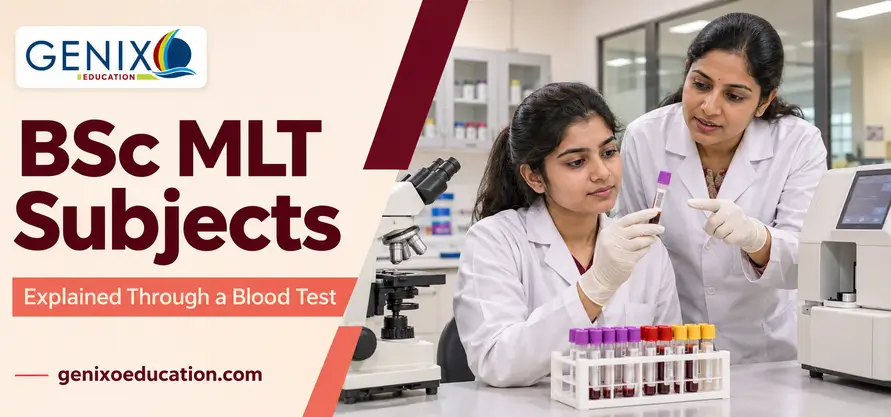
You give a blood sample at a clinic and receive a report later that day. Between those two moments, someone has checked the sample, prepared it for testing, worked with laboratory equipment and helped produce a reliable record of the results.
If you are considering BSc Medical Laboratory Technology, or BSc MLT, that journey gives you a useful way to understand the course. The subject names become easier to follow when you connect them to work you might learn during supervised training.
First, the sample has to belong to the right person
Imagine two patients arriving for tests a few minutes apart. Their samples may look similar, but each must remain connected to the correct patient and test request.
Before testing, laboratory staff receive and register samples and check whether they are suitable for the requested examination. A problem at this stage can affect everything that follows.
For a student, this explains why record-keeping and careful handling deserve as much attention as learning to use a machine. Ask a college how it teaches these routines during practical sessions. What happens if a label is unclear? Who does a student ask for help?
Different BSc MLT subjects answer different questions
A blood sample can be used for different investigations. The test requested determines how it is handled and which laboratory section receives it. These examples explain three areas you may encounter in the course.
|
Subject |
What it covers in simple language |
An example students may learn about |
|
Haematology |
Blood and its cells |
Measuring haemoglobin and counting blood cells |
|
Clinical biochemistry |
Substances measured in blood and other samples |
Measuring glucose |
|
Microbiology |
Microorganisms and laboratory methods used to investigate them |
Learning how suitable specimens are examined for bacteria |
These are examples of study areas, rather than a semester timetable. Universities may arrange the subjects differently. Read the syllabus for the exact programme you are applying to.
You may also study blood banking, tissue preparation and other laboratory disciplines. One blood-test example cannot represent everything covered by medical laboratory technology.
A machine reading needs checks
Suppose an analyser produces a number on its screen. How does the laboratory know the testing process is working properly?
This is where quality control comes in. Laboratories use control materials and set procedures to check test performance. If those checks fall outside acceptable limits, staff investigate and take corrective action before affected results are released.
In class, you may come across words such as accuracy and precision. During training, you begin to see why they matter. The aim is to produce measurements that the healthcare team can rely on. Ask whether students practise quality checks and discuss what happens when a check fails.
The result becomes part of a report
Testing is followed by recording, review and authorised release of results. A report needs the correct patient details, the examinations performed and other information required by the laboratory's procedures.
Students should understand how their assigned tasks fit into that process. Ask who supervises their work, who reviews results and which responsibilities they can take on as their skills develop.
For parents visiting a college, this is a helpful conversation to have with the teaching team. Ask them to explain a student's journey from the first practical class to a hospital posting.
What should you check before choosing a college?
Request the current syllabus and look at the practical teaching alongside the theory. A list of instruments tells you what equipment is available. You still need to find out how often students use it and who teaches them.
Ask where clinical postings take place, which departments students rotate through and how practical skills are assessed. Confirm the full course duration, internship arrangements and fees in writing for your admission year.
When comparing BSc MLT colleges in Bangalore, keep those answers together. They will help your family compare what each college actually offers beyond its course brochure.