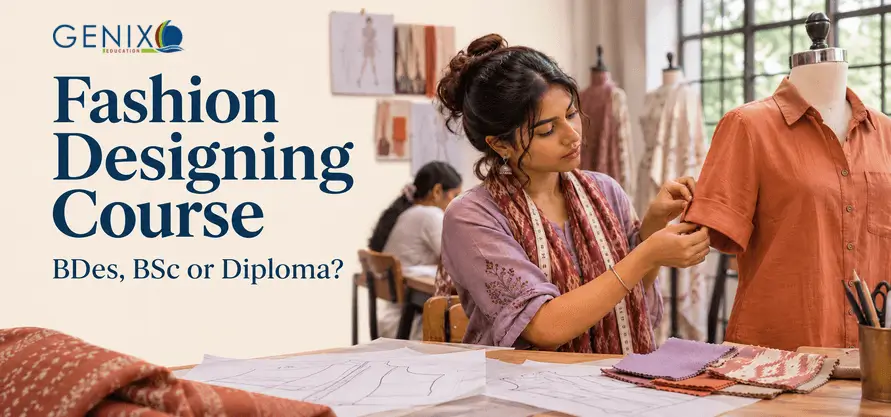
A fashion designing course teaches you how to turn an idea for a garment into something someone can wear. You learn to sketch, choose fabric, make patterns, sew samples and check the fit. After Class 12, you can compare a BDes in Fashion Design, a BSc in Fashion and Apparel Design, and diploma options. The syllabus and student projects will show you how much time each course gives you to make things yourself.
What do you learn in a fashion designing course?
A shirt can look great in a sketch and still pull at the shoulders when someone tries it on. In class, you might work out whether the problem comes from the sleeve shape, the measurements or the fabric. That might mean changing the pattern, which is the set of shapes you use to cut the pieces of a garment, and making another sample.
You may also learn draping, where you arrange fabric directly on a dress form to see how it hangs and where it needs shaping. The National Institute of Fashion Technology includes draping, pattern making and garment construction in its undergraduate Fashion Design programme. NIFT Fashion Design programme
BDes, BSc or diploma after Class 12?
When comparing fashion designing courses after 12th, ask for the syllabus for the exact programme and campus. Here’s what to look for in each route.
| Course route | What to check |
|---|---|
| BDes in Fashion Design | Look for studio projects where you develop an idea, test fabrics and present a finished garment. Ask how tutors give feedback while the work is still in progress. |
| BSc in Fashion and Apparel Design | Look for practical classes in textiles, pattern making and garment construction. Ask what pieces students are expected to make and how their work is assessed. |
| Diploma in Fashion Design | Check the qualification, course length and delivery mode. Ask how much supervised sewing and pattern work you’ll get. Some diplomas, such as IGNOU’s Diploma in Fashion Design and Retail, also cover retail. |
You can see how the courses are structured in the Bengaluru City University Fashion and Apparel Design syllabus and the IGNOU common prospectus.
What might a student project look like?
Imagine you’re asked to make a shirt for a student who takes the bus to college. They need to reach the overhead handrail, keep their ID card handy and wash the shirt regularly. You sketch two ideas, pick a fabric and sew a trial version.
During the fitting, the sleeve pulls when the wearer raises their arm. The ID card also slips out when they bend down. You adjust the sleeve pattern, change the pocket and try again. When you visit a college, ask to see a sample like this alongside the sketches and earlier versions. The changes tell you what students learned along the way.
What should you check before applying?
- Admission requirements. Check the accepted Class 12 subjects and any minimum marks. Ask whether selection includes an entrance test, interview or portfolio.
- Workshop access. Find out when you can use sewing machines and cutting tables. Ask whether students can finish projects outside scheduled practical classes.
- Materials and costs. Get an idea of what you’ll spend on fabric, sewing tools and printing in addition to tuition. Ask which materials the college provides.
- Recent student work. Look at projects from different semesters. Ask a student which pieces they made themselves and how often they had a chance to revise their work.
If you’re looking locally, use Genixo’s guides to BDes colleges in Bangalore and BSc Fashion and Apparel Design colleges in Bangalore to build a shortlist. Take the same questions to each college so you can compare their answers.
Do you need to be good at drawing before you apply?
Check how your chosen programme selects students. If it has a drawing or design test, look at the institute’s official sample questions so you know what to practise. For a garment project, a rough sketch can communicate a lot if it clearly shows where the seams, pockets and fastenings go.