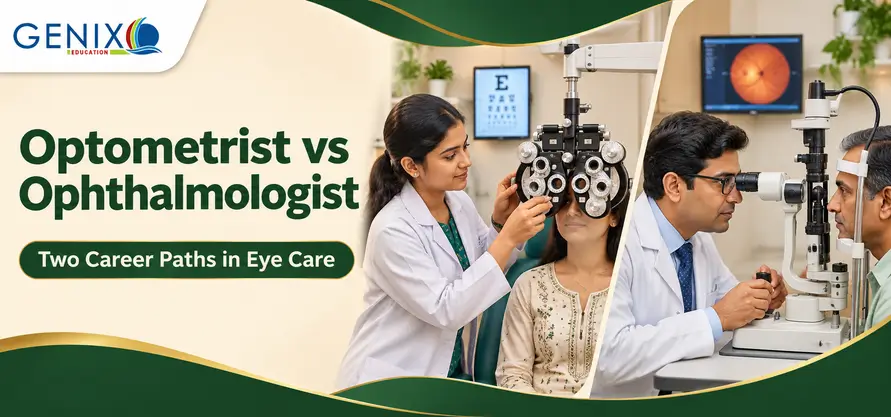
Ananya can read her notebook from her desk, but she has started moving to the front row because the writing on the board looks blurry. At an eye clinic, an optometrist asks her to read from a chart and tries different lenses to see which ones make the letters clearer. If the examination points to something that needs further medical assessment, the optometrist can refer her to an ophthalmologist.
A student watching that appointment might wonder which job they would enjoy. The answer depends partly on what they want to learn. Optometry has its own undergraduate training route. Ophthalmology is a medical specialty you pursue after MBBS.
What would you do as an optometrist?
If someone has ever asked you, “Which looks clearer, lens one or lens two?”, you’ve seen part of a vision test called refraction. It helps work out which lens power gives a person clearer vision. An optometrist learns to carry out tests like this and use the results to help people with their vision.
Some appointments take patience. A child may keep guessing at the letters because they want to get the answer right. Someone wearing contact lenses for the first time may need several attempts to put one in. Depending on their training and workplace, optometrists may fit contact lenses, help people use low-vision aids or refer patients for further assessment.
If you like working with instruments and explaining things to people who are unsure what to expect, that combination is a good reason to explore optometry.
What would you do as an ophthalmologist?
An ophthalmologist is a doctor who specialises in eye health. They examine patients, diagnose eye conditions and discuss treatment. Depending on their specialty and training, their work can include surgery.
Imagine Ananya’s grandfather says the television looks cloudy even with his glasses on. An ophthalmologist can examine his eyes to see whether a cataract or another condition could explain the change. If they find a cataract, they can discuss how it affects his daily life and whether surgery would help.
For a student, it’s worth thinking about the years before that appointment. You’ll study medicine across different areas of health before you train in ophthalmology. If examining and treating eye disease appeals to you, consider whether that broader medical training appeals to you too.
What should you study after Class 12?
For optometry, look at undergraduate programmes such as Bachelor of Optometry or BSc Optometry. Check the exact qualification each institution awards and read its current admission notice. Ask where students practise, who supervises them and how the internship is arranged.
For ophthalmology, the route starts with MBBS and continues with postgraduate training in ophthalmology. If you’re still in school and thinking about this route, your first decision is whether you want to study medicine. Choosing an eye specialty comes later.
Ask a student about their last practical session
If you visit an optometry college, try asking a current student, “What did you do in your last practical session?” They might describe testing a classmate’s vision in a lab, observing a clinic appointment or carrying out part of an examination under supervision. Follow up by asking when students move from observing to practising and who gives them feedback.
If you’re comparing two colleges, write down three things for each: where the training takes place, what students get to practise and who arranges the internship. You can use those notes to compare the training alongside fees and travel. Genixo lists BSc Optometry among its Allied Health Sciences courses in Bangalore.